Tuesday, October 30, 2007

Elin Johansson, student of Hyper Island Business Management 06, has given us an update about her visit in Japan. She’s there for internship interviews - but also to get inspired by meeting new people, discover an exciting culture and see things she haven’t seen before.
One of her scheduled interviews is at IKEA and she hopes to become a part of their business development team. Between interviews she also has had the time to do karaoke, eat squid by mistake and practice her poor Japanese.
Japan has been on her must-visit-list since long time ago. And Tokyo definitely measures up to her dreams. She thinks that the best part of the trip so far was walking up and down at the streets in Harajuku. But she also likes to visit the arcades or sit at a café in rush hour watching all the people run by and just dream away. She is fascinated by the consumption that exists in Japan and tries her best not to exceed the 23 kilo luggage weight limit.
She is filled with thoughts about the working culture and sees a big difference between what she learned and practiced at Hyper Island and real life in Tokyo. Watching business men sleeping on the subway and at the same time read that they spend about 4 minutes every day with their children gives her lots of ideas about how to develop company culture.
Read more about her experience in Tokyo on her blog.
Sunday, October 28, 2007

Stina Norgren, student at the Interactive Art Director program in Stockholm, tells us about their latest module:
At the moment we are in the end of an 8 week module called Interactive User Experience. The main goal for this module is for us to understand the main process, digital tools and the trends related to an interactive user experience.
That’s what the course plan says but what are we really doing? Everyone is really busy at the moment since our class got one big challenge ahead of us. This is the first year that our class exists; there haven’t been any Interactive Art Director classes before us. And on top of that Hyper Island got the school at a totally new location, Stockholm… This brings us one big problem to solve. How are we going to let the world know that we are here? And how do we communicate ourselves and why should anyone care? This undertaking is really important considering that we are the first class of our kind.
Working with this task simultaneously as we are working on one sharp project from Doberman can be a bit confusing from time to time. But in the end the feeling of playing creative is so worth it. Coming up with new ideas and solving problems is a big kick and that’s why we are here.
Lots of love
/Stina Norgren
Friday, October 26, 2007

John Lester, known as Pathfinder Linden in the Second Life virtual community, has worked with Second Life’s creators Linden Lab since 2005. In 1993 he pioneered the use of the web to create online communities for supporting patients dealing with neurological disorders, as Information Technology Director in the Neurology Service at Massachusetts General Hospital. He visited Hyper Island in Karlskrona to talk about how Second Life can be used as a platform for education and general learning, focusing on strategies for success. Digital Media student Erik Jonsson bringextradragons.blogspot.com reports on his visit:
Lester was grabbed in passing to give us a lecture about the Second Life network. It’s an online social role playing world where users are given avatars, designed and named by themselves. What makes this online world different from others and thus motivates a lecture to the Hyper Island Digital Media class is the freedom of creation the platform offers.
The concept of the online world is built on a grid where users with their avatars can walk around and create their own reality as far as visual content and sound goes. Scripts can be applied to their homemade environment as well with semi-advanced building tools supplied to make constructions like buildings and vehicles possible. This is more or less what you expect from any system like this online. What makes it really interesting to us students currently involved in a module about business ideas is the economy.
Second Life comes with an monetary economy of its own where you exchange your US dollars into the world’s own currency. Thus making it possible for anyone taking part in the network to realize their own ideas, may it be selling or buying, renting or lending user created content. As there are literally no rules of engagement in this world and content in a users property is moderated only by the owner of the land visitors set foot on possibilities to some seems unlimited.
If you can make your online idea appealing enough to visitors, whether it might be a programmed game, a concert hall or just a tranquil garden, it’s still yours to profit from. Theoretical examples Lester brought up on this is to mention just a few; education, live music, co-developing and online meetings. Practical use of these might be e-learning classes for students spread around the world, an architect realizing a blueprint into a 3dbuilding together with a colleague or whats come to be the most popular Second Life event yet, Artists making live appearances.
As stated this network offers a multitude of services either free or payed for with real money. Issues that seems to bother us students overhearing this lecture where the more or less obvious downsides to a system like this. For starters a world built on user created content can’t be pre-stored locally on users computers. Its streamed live from servers which puts a pretty heavy quality threshold on the graphics. As far as we are concerned it might have been an application from 2002 and not present. Knowing that fancy uptodate graphics might not be the primary need for Second Life:s user base this could be overlooked.
What disturbs us more was that people tend to pick a to most people offensive looking avatar as their physical representation in the world. Offensive in this case meaning a big pink robot wearing a tuxedo or a dwarf in a bikini. Knowing that this is just extreme examples these characters still make out the bulk population of the world. A direct reaction to this is that it might be hard to take someone seriously given the factor of the looks added to the already harsh filter on humanity online-mode is to us.
Which brings me to the third issue of the expanding world of possibilities second life is. The ever ongoing digitalization of our social life. To most people text chat or as of late voice chat to replace regular telephony suffices as far as digital communication goes. Being in this very module, oriented around online marketing and services generating economical revenue, these are of course not great obstacles to overcome for a young creative constantly on the lookout for new areas and platforms to spawn ideas into. It’s just that the lecture about Second Life, the possibilities, the looks and the inhabitants left us a bit reluctant and puzzled.
All in all the environment felt perhaps too unmoderated for our Scandinavian (with some exempts) culture. Perhaps too colorful to take serious or to withstand the test of time. Which might be illustrated in a current example with the exodus from previous social networks with more user created content to the syndicated environment of Facebook. After a brief inquiry in the class following John Lester's lecture just a handful had ever tried Second Life and not many saw it as a lasting medium for planting business ideas to grow.
Erik Jonsson
Tuesday, October 23, 2007
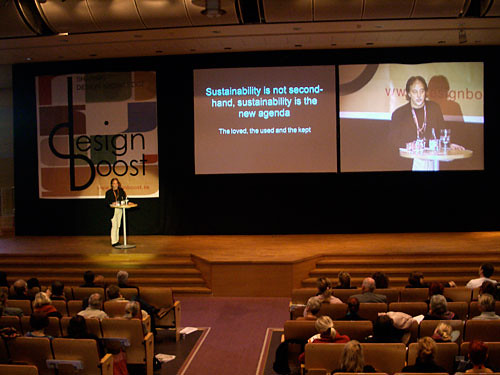
Digital Media student Johanna Boäng visited Designboost , that took place between the 17th and 19th of october in Malmö. Here is her story on the event:
As a student of Digital Media at Hyper Island in Karlskrona, I was invited to go to Malmö last week to take part in Designboost, a new, annual meeting between different types of practitioners within the international design industry.
It is a new concept on the Swedish design market, where participants spend day one on the boost meetings to discuss current issues (this year focusing on sustainable design), day two at the boost chats, and day three visiting the boost show. The boost meeting are open to invitation only, while the boost chats and boost show are open to the public.
Designboost is an initiative by David Carlson, who works as an consultant with design and brand development issues, and Peer Eriksson, who has his own communications agency, together with City of Malmö and Region Skåne.
- It’s important to look upon things from a new perspective and be given a push forward, which is exactly what the word boost means. When it comes to sustainable design it’s likely that things need to be questioned. Since the world is constantly changing and the maps rewritten it’s impossible to sit around and wait, says Peer Eriksson.
-There are plenty of design events in Sweden. We want to create a different and unique arrangement that will function as a creative arena and meeting point that gathers people, companies, organisations, institutions and schools that all work with design, in one way or another, David Carlson says.
Personally I had a very exciting three days, and I feel very fortunate I got the opportunity to attend. The first day, the boost meetings, were held at the top two floors of the Turning Torso tower in Malmö. We were 10 groups with 7 participants in each (though at least one person was absent in each group), having discussions in three rounds of 2 hours and 15 minutes each, changing groups for each round. My three groups got to discuss the following subjects:
” Every time you spend money, you’re casting a vote for the kind of world you want. How can the consumers best use this power to take active part in the development of a sustainable future?”, “How can we use design to create a sustainable society?” and “How can we define sustainable design?”.
The second day took place at Europaporten, and consisted of a number of interesting lectures, most of them 18 minutes long, and some of them extended to about 40 minutes. It gave a new dimension to the meetings the previous day, especially as many of the people talking had been in my discussion groups. It was a day full of inspiration and interesting view-points.
The Thursday was concluded with dinner at the beautiful town hall of Malmö where we could continue conversation, before some headed back to their home countries and others to the after party at a nearby night club.
On the Friday the boost show opened at Fridhemstorget in Malmö, displaying different types of products that have been produced with a sustainable future in mind. Entrance to this exhibition is free, and if you happen to visit Malmö before its closing day November 17, you really should check it out.
What did I get out of this experience myself? Well, it opened up my thinking to new possibilities for the design of the future, rather than restrictions, and I feel highly inspired. I added to the philosophy of my own design work a kind of fourth dimension. Instead of as usual thinking in 2D or 3D when designing, why not think in 4D? Sustainable design starts with a sustainable thought process, and a long-term perspective.
Cheers to David and Peer for their work with Designboost!
Johanna Boäng
Monday, October 22, 2007
Besides this place, the official Hyper Island blog, the blogosphere is filled with Hyper Island related stuff.
There are right now over 50 individual Hyper Island student blogs, where the students are documenting their work in a first-person narrative.
If you are interested in the Hyper Island education these blogs have lots of valuable information, but keeping track of them all is pretty hard so we've made it a little bit easier for you.
At the bottom of the right sidebar (and below in this post) you will find a widget showcasing the RSS feeds from the Hyper Island student blogs, as well as a link to the Yahoo Pipes page we use to parse all the blog feeds.
PS. If you have a Hyper Island blog and we've missed you, let us know!
Friday, October 19, 2007
Well, we gave you the Experience Technology blogs, we gave you the Experience Technology magazine, but your life will not be truly fulfilled before you've seen the Experience Technology movie. Check it out:
Monday, October 15, 2007

The Digital Media students in Stockholm and Karlskrona collaborated on a magazine documenting their Experience Technology module. Check it out here!